
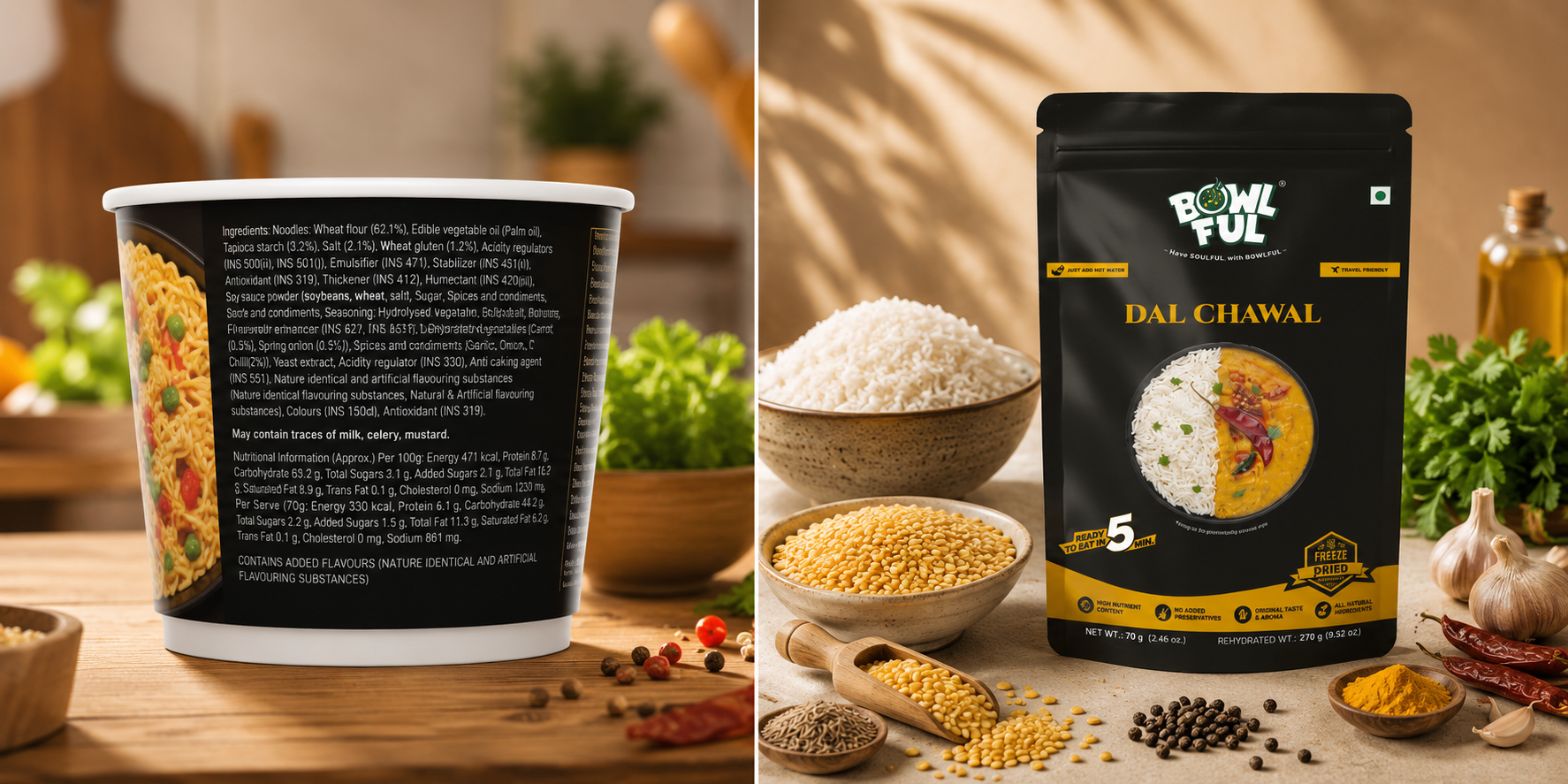
There's a word that gets used loosely in Indian kitchens. "Instant food." It usually means Maggi. Or cup noodles. Or something that comes in a foil pouch you rip open, add boiling water to, and try not to think too hard about what's inside.
Bowlful gets called instant food too. And technically, yes, it's ready in 5 minutes, just add hot water. But what's inside the pouch is completely different. And the difference matters more than most people realise.
What "instant food" actually means
Most instant food in India uses one of two preservation methods. The first is dehydration, which removes water through heat. This damages nutrients, changes texture, and usually requires artificial flavours and preservatives to make the result taste like anything. The second is retort processing, which is essentially pressure-cooking food inside its sealed pouch at very high temperatures. This kills bacteria and extends shelf life, but also breaks down vitamins, changes texture, and produces that characteristic pouch smell that anyone who has eaten an MTR or Gits meal on a long train journey knows well.
Both methods work. Both produce shelf-stable food. Neither produces food that tastes or nourishes the way a fresh meal does.
What freeze-drying actually does
Freeze-drying is a different process entirely. The food is cooked fresh, then frozen at -40°C, then placed in a vacuum chamber where the ice sublimates directly into vapour with no heat involved. What's left is the original meal with 97% of its nutritional content intact, all its original flavour compounds preserved, and none of the texture breakdown that heat processing causes.
When you add hot water, the food rehydrates back to something remarkably close to what it was when freshly cooked. Not a simulation of dal chawal. Actual dal chawal, dehydrated and brought back.
This is the process Bowlful uses. No heat, no preservatives, no artificial flavours. Just real food with the water removed.
Why it matters for what you eat every day
If you're eating instant food occasionally, on a train, during travel, when nothing else is available, the difference between retort and freeze-dried matters less. You're eating it once. The compromise is acceptable.
If you're eating it regularly, as a kitchen staple, as a backup for weekday evenings, as something you rely on two or three times a week, the difference matters a lot. What goes into your body repeatedly is what shapes your health over time.
Bowlful was built for the second use case. Not the emergency. The everyday. The meal you reach for on Tuesday evening when you're tired and the last thing you want to do is cook, but you still want to eat something real.
The Maggi comparison
Everyone loves Maggi. That's not the point. The point is that Maggi exists in a category of its own, fast, cheap, deeply satisfying in a specific way, but it doesn't nourish you the way a dal chawal or a paneer butter masala does. It fills the gap but doesn't feed you.
Bowlful fills the same gap. Same 5 minutes, same zero effort, same "I cannot be bothered to cook tonight" moment, but delivers a complete Indian meal with full nutrition, real ingredients, and no preservatives.
That's not instant food. That's something better.
How to use Bowlful as a kitchen staple
Keep 4 or 5 pouches on your shelf. Dal Chawal, Dal Makhani, Paneer Butter Masala, Khichdi Kadhi. They sit there for 12 months. They cost less than a delivery order. On the evenings you can't cook and don't want to order, they're there. 5 minutes. A real meal. Done.
[Explore Bowlful's full range]
Frequently Asked Questions
What is freeze-dried food?
Freeze-drying is a preservation process where freshly cooked food is frozen at -40°C and placed in a vacuum chamber where the ice converts directly to vapour without becoming liquid. This removes moisture without using heat, preserving 97% of the food's nutritional content, all its original flavours, and its original texture. When hot water is added, the food rehydrates back to its freshly cooked state.
Is freeze-dried food healthier than regular instant food?
Yes. Regular instant food uses heat during processing which destroys a significant portion of vitamins and nutrients. Freeze-drying uses no heat, so nutritional content is preserved at 97%. Bowlful's freeze-dried meals contain no preservatives, no artificial colours, and no artificial flavours.
How is Bowlful different from MTR or Gits ready to eat food?
MTR and Gits use retort processing, which pressure-cooks food inside its sealed pouch at high temperatures. Bowlful uses freeze-drying with no heat and no preservatives. The result is higher nutritional content, better texture, and no need for additives to maintain flavour.
How long does Bowlful freeze-dried food last?
12 months from the date of manufacture when stored in a cool, dry place. No refrigeration required.
Is Bowlful the same as instant noodles?
No. Instant noodles are made from refined flour, flavour powders, and preservatives. Bowlful meals are made from real Indian ingredients, rice, lentils, vegetables, paneer, whole spices, cooked fresh and freeze-dried. No maida, no flavour packets, no MSG.
Can I eat Bowlful every day?
Yes. Bowlful meals are made from 100% natural ingredients with no preservatives or artificial additives, making them suitable for regular daily use as part of a balanced diet.
What is the difference between freeze-dried and dehydrated food?
Dehydrated food uses heat to remove moisture, which damages nutrients and changes texture. Freeze-dried food uses vacuum and low temperature, preserving 97% of nutrients and original texture. Freeze-dried food also rehydrates better and stays much closer to the original freshly cooked meal.
Share:
5 Freeze-Dried Indian Meals to Stock Before Monsoon Hits
The Complete Guide to Jain Ready to Eat Food - Travel, Abroad, Office, and Home