
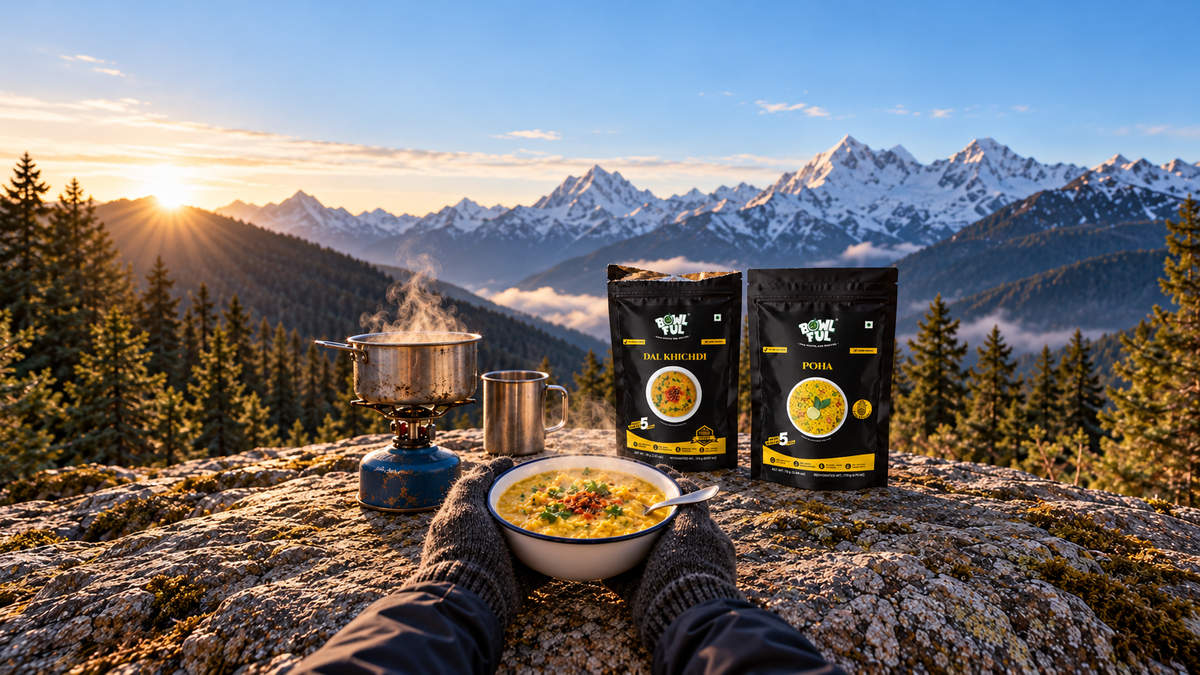
On a multi-day trek, food has three jobs: give you enough energy to keep walking, weigh as little as possible, and be easy to make when you're cold and tired at the end of the day. Most trekkers end up living on Maggi, biscuits and whatever the teahouse serves. That works for a weekend. On a 6-day Himalayan trek, it leaves you short of energy by day three.
This guide is for Indian trekkers doing self-supported or partly self-supported treks, such as Kedarkantha, Hampta Pass, Kuari Pass or the Valley of Flowers, and for anyone camping where there's no kitchen. It covers how much to carry, what to eat when, and why freeze-dried food suits trekking.
Why freeze-dried food works on a trek
Freeze-drying removes almost all the water from cooked food at very low temperatures. You carry the meal without its water and add the water back at camp. For a trekker, that means:
- Low weight. A Bowlful dal khichdi weighs 50 g dry and becomes about 250 g of food once you add water. Most of our mains weigh 50–80 g a pack.
- No cooking. You only need hot water, not a pot of rice on a stove, so you use less fuel and less time.
- No fridge. Unopened packs keep for 12 months at room temperature.
- Real food. Dal, rice and sabzi digest more easily at altitude than the third packet of instant noodles.
How much food to carry per day
Trekking at altitude burns far more energy than a normal day, often 3,000 calories or more for an adult carrying a pack. Appetite usually drops as you go higher, so food you actually want to eat matters as much as the numbers.
A simple rule for self-supported treks: one hot breakfast, one hot dinner, and snacks in between. Lunch on the trail is usually snacks rather than a cooked meal, because stopping to boil water at midday wastes daylight.
A sample 3-day trekking meal plan
| Day | Breakfast (hot) | On the trail | Dinner (hot) |
|---|---|---|---|
| Day 1 | Poha (70 g, 100 ml water) | Dry fruit, chikki, theplas | Rajma Chawal (70 g, 200 ml water) |
| Day 2 | Upma (60 g, 190 ml water) | Peanuts, dates, energy bars | Dal Khichdi (50 g, 200 ml water) |
| Day 3 | Poha | Khakhra, dry fruit | Veg Biryani + Moong Dal Sheera as a summit-day treat |
Weight of the hot meals for 3 days: about 450 g dry. The same food in retort pouches would weigh well over 1.5 kg.
Which dishes are best for trekking

- Dal khichdi: the lightest and most gentle on the stomach at altitude. If you take one dish, take this.
- Poha and upma: quick breakfasts that need little water, which matters when water is scarce or must be melted from snow.
- Rajma chawal and dal chawal: filling dinners with protein from the lentils and beans.
- Moong dal sheera: calorie-dense and warming. A good reward after a long day.
Rich, creamy dishes such as paneer butter masala are better saved for lower camps. Heavy food is harder to digest when you're high up and short of breath.
Making freeze-dried meals at altitude
Water boils at a lower temperature the higher you go. Around 4,000 m it boils at roughly 87°C instead of 100°C. The meal still rehydrates, just more slowly.
- Bring the water to a full boil.
- Open the pack and remove the small oxygen absorber sachet.
- Pour in the amount of water printed on the pack, stir well and reseal.
- Wait 5 minutes at lower camps. Above about 3,500 m, give it 8–10 minutes and keep the pack inside your jacket or a cosy so it stays warm.
- Stir and eat from the pack. No dishes to wash, which matters when water is cold and scarce.
Carry out every empty pack. The pouches are light and fold flat. Leave nothing on the mountain.
Packing tips

- Put each day's meals in a separate zip bag, so you don't dig through your whole pack at camp.
- Keep one spare meal for bad-weather days or delays.
- Bring a long spoon. Eating from a deep pouch with a short one is harder than it sounds.
- If you're trekking with a group, coordinate the stove, fuel and water so you aren't all boiling separately.
Frequently asked questions
Is freeze-dried food healthy enough for a long trek?
It's normal cooked food with the water removed, so it keeps the ingredients of the original dish. On a trek, balance it with snacks such as dry fruit and nuts for extra calories during the day.
Can I eat it without hot water?
Hot water works best. Cold water takes much longer and the texture is not as good. Treat cold rehydration as an emergency option only.
How long do the packs last?
12 months unopened, with no refrigeration. Once you add water, eat the meal straight away.
Build your trek pack: all Bowlful meals · cup meals · trekking abroad? Read the customs guide.
Share:
Can You Carry Ready-to-Eat Indian Food Abroad? Customs Rules by Country (2026)