
Last checked against official government guidance: October 2026. Rules change, so always confirm with the official source linked for your country before you fly.
Ready-to-eat Indian meals are the easiest home food to travel with. They're sealed, light, and they don't need a fridge. They are still food, though, and every country decides what food comes through its border. The short version: declare everything, and pay attention to dairy.
This guide covers the five places Bowlful customers travel to most: the USA, the UK, Canada, Australia and the UAE. It explains what usually goes through without trouble, what gets taken away, and how to pack so customs is quick.
The two rules that apply everywhere
- Declare all food. In every country here, food you declare and that turns out not to be allowed is simply taken away. Food you don't declare can bring a fine. Australia is the strictest example: undeclared food can mean an on-the-spot penalty, and in serious cases a cancelled visa.
- Keep it sealed and labelled. Commercially packed food in its original pack, with the ingredients printed on it, is far easier to clear than anything homemade in a box. Officers need to see what's inside without opening it.
Why dairy is the real question
Most border rules about food exist to keep out animal diseases. That's why meat is restricted almost everywhere, and why dairy from India is restricted in some countries. All Bowlful meals are vegetarian, so meat is never an issue. Many Indian dishes, though, are cooked with butter, ghee, paneer or cream, and that includes most of ours.
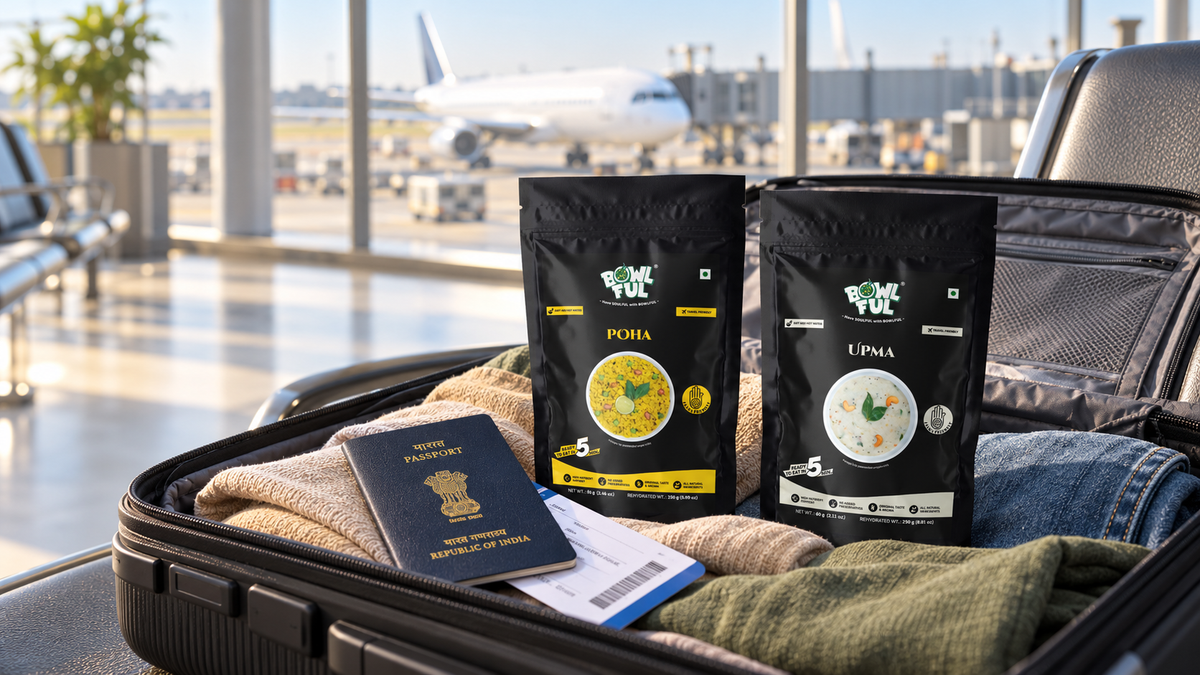
Two Bowlful breakfasts list no dairy ingredients at all: Poha and Upma. If you're heading somewhere strict about dairy, build your stock around these, and check the ingredient list on every pack you take.

Country by country
United States
The US is one of the easier destinations for vegetarian packaged food. The USDA allows commercially packaged, labelled, cooked and shelf-stable food in unopened packages. Hard cheeses and butter are on its list of products that may enter from any country. You must still declare all food and agricultural products on arrival. Meat products are the main restriction, which doesn't affect Bowlful.
Practical advice: declare the meals, keep them in their original packs, and carry a reasonable personal quantity. A few weeks' supply reads as personal; several cartons reads as commercial.
Official source: U.S. Customs and Border Protection: prohibited and restricted items.
United Kingdom
The UK is strict about animal products. Personal imports of meat and dairy from outside the EU are restricted, and the UK government's own guidance lists dairy among its restricted categories. Meals cooked with butter, ghee, paneer or cream may be taken from you at the border, even though they are fully cooked and sealed.
Practical advice: for the UK, choose the dairy-free meals listed above, declare everything, and expect dairy-based curries to be at risk. Ordering to a UK address means the parcel goes through the same import rules.
Official source: GOV.UK: bringing food into Great Britain. Use its country checker for India.
Canada
Canada allows food for personal use within set limits, and the limits depend on the product and where it comes from. In many cases the limit is 20 kg or 20 litres per person. All food must be declared to the border agency (CBSA). The Canadian Food Inspection Agency has a lookup tool, AIRS, that shows the exact rule for a product from a specific country.
Practical advice: declare everything, stay well within personal quantities, and run your products through AIRS if you're carrying a large supply for a semester.
Official source: CFIA: bringing food into Canada for personal use.
Australia
Australia has the strictest biosecurity rules of any common student destination. Its government lists dairy, along with home-cooked meals, among the foods travellers cannot bring in from many countries, and every food item must be declared on your Incoming Passenger Card. Bags are checked by X-ray and detector dogs. If you declare food and it isn't allowed, it's taken away with no penalty. If you don't declare it, you can be fined.
Practical advice: assume dairy-containing meals will not be allowed. Take only dairy-free options, pack all food together at the top of your bag, and tick "yes" for food on the card. Check the item in BICON, Australia's import conditions database, before you fly.
Official source: Australian Border Force: can you bring it in?.
United Arab Emirates
The UAE is generally relaxed about packaged vegetarian food for personal use, and ghee itself can be carried in checked baggage within quantity limits. Two things to watch: some guidance restricts home-cooked food, so keep everything in sealed commercial packs; and poppy seeds (khus khus) are banned outright, including in food. Check the ingredient list of anything you carry for poppy seeds.
Official source: Dubai Customs and the UAE Federal Authority for Identity, Citizenship, Customs and Port Security.
How to pack ready-to-eat meals for an international flight

- Checked bag, not cabin. The dry packs are fine in cabin baggage, but keeping food together in your checked bag makes the customs check simpler.
- Keep them together, near the top. If you're asked to show your food, you shouldn't have to unpack the whole suitcase.
- Carry a list. A note on your phone with the dish names and quantities helps when an officer asks what you're bringing.
- Watch the weight. Freeze-dried meals weigh under 100 g each, so 30 meals is around 2–3 kg. That's a fraction of what the same food weighs in retort pouches or tins.
- Keep the oxygen absorber in. Each pack has a small sachet that keeps it fresh. Remove it only when you're about to eat.
Carry it, or have it delivered?
Bowlful ships to the USA, Canada, the UK, the UAE and Australia. Delivery saves luggage space, but a parcel goes through the same import rules as your suitcase, so choose dishes for your destination the same way. For a first semester, many students carry a 15-day supply in their luggage and order more once they've settled in. Browse all Bowlful meals.
Frequently asked questions
Do I have to declare ready-to-eat meals if they're sealed?
Yes. In the USA, UK, Canada and Australia you declare all food, sealed or not. Declaring costs nothing. Not declaring is what gets people fined.
Is freeze-dried food treated differently from other food at customs?
Not as a category. Customs look at what the food is made of, such as meat or dairy, and where it was made, not how it was preserved.
Can I take ghee or butter-based curries to Australia?
Assume not. Australia restricts dairy from many countries, and confiscation is likely. Take dairy-free meals and declare them.
How much food can I carry?
Keep to a reasonable personal quantity. Canada publishes limits (often 20 kg or 20 L per person). Elsewhere, quantity is judged on whether it looks personal or commercial.
This guide gives general information, not legal advice. Border rules are set by each country and can change without notice; the official sources linked above have the final word.
Related: Best ready-to-eat Indian food for travel abroad · Indian food for students studying abroad · Diwali away from home · Freeze-dried trekking food.
Share:
Diwali Away From Home 2026: How to Get the Taste of Home Abroad
Freeze-Dried Trekking Food: What to Eat on a Himalayan Trek (Indian Meal Plan)